Your Own Website Is the Most Expensive Place ChatGPT™ Sells You
TODD PIECHOWSKI · JUN 15, 2026 · 4 MIN READ
I asked ChatGPT™ to help me buy a pair of Nike leggings last week.
It showed me Nike.com first. $95. Then, right below, the same leggings at Zappos, DICK’S, and Backcountry — all right around $71.
Nike’s own site was the most expensive place to buy Nike.
That stuck with me, so we ran it properly. We asked ChatGPT™ to shop about 100 top DTC brands the way a real shopper does, with “best leggings,” “best nonstick pan,” “best water bottle,” no brand names, and pulled every product it put on the shelf, every merchant, every price. 112 products across 34 categories.
And it kept happening, brand after brand.
The brand’s own store is almost always the priciest door
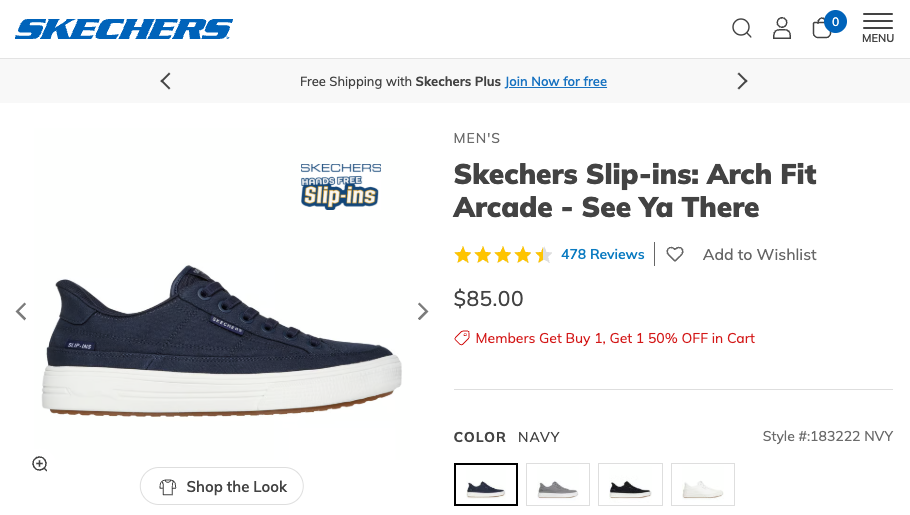
Over and over, the most expensive place ChatGPT™ listed a product was the brand’s own website. Skechers walking shoes ran $70 on Skechers.com and $52 at Macy’s. Hourglass blush was $38 on its own site and $30 at Ulta. Vince cashmere went for $468 direct and $398 at Nordstrom. Every time, the brand’s store was the high-price option, and ChatGPT™ put a cheaper one right next to it. Same product, one screen, one scroll.
Some of this is just retail working the way retail works. Macy’s running a sale is a discount the brand sort of signed up for. Authorized retailers discount, that’s the deal. But the shopper doesn’t see “authorized retailer.” They see your product, your price, and a lower number sitting right underneath it.
Then there’s the resale shelf
ChatGPT™ doesn’t stop at real retailers. It pulls from the secondhand market too. A used J.Crew cashmere sweater on Poshmark for $105, next to the new one for $148. Old Navy joggers for $18 on Poshmark. A UNIQLO tee for $15 on eBay against $25 direct.
Some of those listings are harmless. Some are gray-market product the brand has no deal with and no idea is getting surfaced as the cheap version of itself, by the tool a billion people now use to shop. Either way, the brand never chose to stand next to that seller. Now it does, every time someone asks.
The part most brands miss
They have more control over this than they think.
The AI shelf isn’t random. ChatGPT™ builds it from product data, feeds, and whatever’s accurate across the open web. When your own information is thin or out of date, the model fills the gap with whatever it can find — a reseller’s listing, a stale price, a marketplace third party. That’s how your own store ends up looking overpriced. ChatGPT™ doesn’t have it out for you. It just found someone else’s data cleaner than yours.
So the fixes are real, and most of them come down to accuracy.
Start with product representation. If your feed is right — current prices, correct titles, in-stock status, the proper buy link — ChatGPT™ is far more likely to show your product correctly and send the buyer to your store instead of rebuilding it from a reseller. Most brands have never checked what their product data looks like from the model’s side. It’s usually thinner than they’d guess.
Then go after the discount and resale sellers. If a gray-market or resale listing is undercutting you on the shelf, that’s a MAP and marketplace-enforcement problem you can actually move on. Clear the listings and the cheap option next to you goes away.
And the simplest one, just look. Most brands have never once seen what ChatGPT™ shows when someone shops their category. Go type “best [your category]” and watch who comes up, at what price, and where it sends the buyer. It takes two minutes and it’s usually a wake-up call.
The shelf is being set right now
Brands that treat the AI shelf like a channel they manage — accurate data, controlled pricing, no rogue sellers undercutting them — are the ones who’ll own it. Everyone else is letting ChatGPT™ decide what their brand is worth and who gets the sale.
We built the scan that turned all of this up. If you want to see what your own shelf looks like — your price, your resellers, who ChatGPT™ is handing your buyers to — that’s the work we do.