eMarketer says OpenAI misses its $100 billion ad target. I'll take that bet.
TODD PIECHOWSKI · JUN 09, 2026 · 9 MIN READ
Open ChatGPT™, ask it how to deal with dry skin, and scroll to the very bottom of the answer. Down there, wedged between the last line of the response and the “Ask anything” box, there’s a little card.
“The Ordinary. Sponsored. Dry Skin Treatments. Lasting hydration to the skin.”
A washed out photo of some products you can’t quite make out. No price. No button. No reviews. Nothing that sounds remotely like The Ordinary, a brand that built a cult by printing “Niacinamide 10% + Zinc 1%” on a $6 bottle & trusting people to care about the difference.
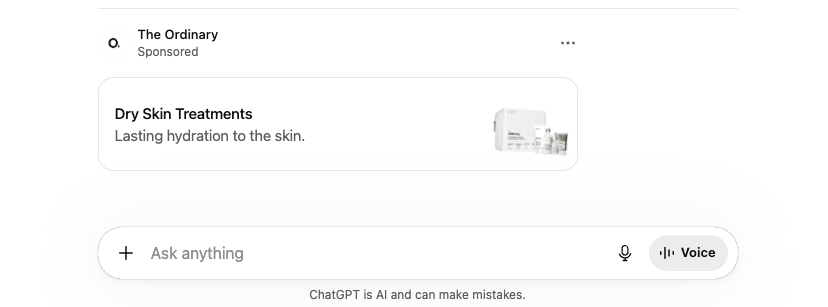
ChatGPT™ Ad Example
It’s a bad ad. Not “needs an A/B test” bad. Bad in the way that tells you nobody has figured out how to advertise here yet.
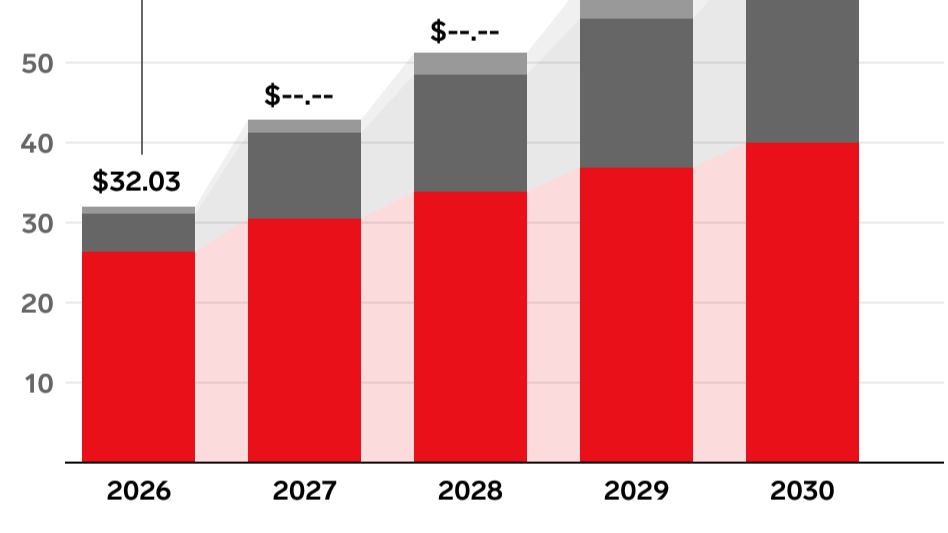
So when eMarketer published its US AI advertising forecast recently, the headline didn’t hedge: “OpenAI Falls Far Short of Its $100 Billion Target.” OpenAI has told investors its ad business gets to $100 billion by 2030. eMarketer says no chance. Their read: advertising inside ChatGPT™ lags, the real money in 2026 flows to search adjacent placements like Google’s AI Overviews, and standalone chatbot ads keep hitting pressure on inventory, pricing, and whether anyone can prove a return. More than 80% of AI ad dollars this year go to those search adjacent units. The ChatGPT™ pilot had maybe 600 advertisers in it. Fewer than one in five eligible users sees an ad on a given day. On the numbers in front of us, eMarketer is right.
I’ll take the other side of that bet. The reason is a folder of Amazon advertising screenshots from about 2014 that live on my computer.
Nobody hated Amazon ads when they came out. Nobody bothered to have much of an opinion at all. When Amazon let brands buy sponsored placements inside its store, the units were ugly. Products that looked like the organic results, dropped wherever there was room, no real targeting. The trade press called Amazon “the sleeping ad giant,” which was a polite way of saying nobody thought the giant would wake up. CNBC ran that exact headline in 2013. The smart take was that Amazon was a checkout lane a place you went to buy the thing you’d already decided on. Why would advertising matter there? Search was where the money was.
Amazon didn’t break out advertising as its own line until 2018, and when it did, it turned out to be a $10 billion business that had been hiding inside a segment literally labeled “Other.” By 2025 it was $68 billion a year. The third largest ad platform on earth, behind Google and Meta, built out of the ugly little units everyone overlooked.
Now sit with the difference. Amazon got to $68 billion while it was beneath notice - nobody forecasting it, nobody writing it off, because nobody was looking. ChatGPT™‘s ad business is months old and eMarketer is already publishing a forecast with OpenAI’s name in the headline saying it falls short. The thing is getting taken more seriously at the starting line than Amazon’s was at the finish.
The audience comparison is what people reach for first, and it’s the part you have to be careful with. ChatGPT™ just crossed a billion weekly active users. Amazon, when its ad business was finding its feet, had a few hundred million accounts. Those aren’t the same kind of user, and pretending they are is lazy. An Amazon account was a person with a card on file who’d already bought something. A ChatGPT™ weekly user might be a kid pasting in homework. Raw reach isn’t the argument.
A real and growing slice of those billion people are typing buying questions. “What should I use for dry skin.” “Best toys for my toddler.” “Is the expensive stand mixer worth it.” That’s the exact high intent query Google built a $200B business on except it now lands inside a system that read the full context, can ask follow ups and is forming an actual recommendation. Retail and grocery already made up 44% of ChatGPT™ ad impressions in the early tracking. The buyers showed up first.
OpenAI turned ads on February 9. Six weeks later the pilot was running at $100 million in annualized revenue. That number gets quoted lazily. “Annualized” means they took a few weeks and projected a year, a run rate, not money in the bank. And $100 million against OpenAI’s own $2.5 billion target for this year is about 4% of the goal with most of the year gone. You can read that as badly behind pace, and eMarketer does. One pilot advertiser committed $250,000 and spent about $2,500 of it in a month. 1%, that’s the bear case.
I read it the other way. That run rate came out of the worst version of this product that will ever exist. Fewer than 1 out of 5 eligible users sees an ad, creative as weak as The Ordinary’s, parked in a footer below the answer where the eye has already left. $100M annualized fell out of a product nobody has optimized yet. The floor is the story.
And OpenAI cannot afford to leave that money on the floor. They sell most of their product at a loss or give it away. They missed revenue targets in Q1, they’re burning cash at an alarming pace, ads are the highest margin dollar in the building and the only lever that scales with a billion weekly users without costing more compute every time. If OpenAI is going to grow into the valuation it wants to go public at, ad revenue is how the math closes. So they’re going to fix the product. The real question is whether they can fix the two things that actually matter and those two things are where eMarketer’s case is strongest.
The first is attribution. Amazon’s ad business didn’t scale because Amazon had shoppers. It scaled because the ad, the decision, and the purchase all happened on one surface Amazon owned so Amazon could show an advertiser exactly what their dollar did. Clean ROAS is why CPCs could climb. That closed loop was the whole moat.
ChatGPT™ doesn’t have it yet. Someone asks for a product rec, sees your ad, thinks about it for two days, then Googles your brand and buys. Google takes the credit. ChatGPT™ gets nothing. Search Engine Land put it right: OpenAI can’t tell advertisers if their money is working. There’s a conversion pixel now, but it only catches the direct click; the influence that happens inside the conversation is invisible. Until that’s fixed, advertisers treat ChatGPT™ as experimental money, not a performance channel and experiment money is small, gets cut first, and doesn’t compound. That’s eMarketer’s strongest point, and today it’s correct.
But cost per action bidding, the first time an advertiser can optimize toward a sale instead of buying impressions and praying turned on just recently. Amazon took six years to break out a billion dollar ad line. OpenAI is building the measurement layer in month four. I’m not betting the loop is already closed. The loop isn’t closed today but it’s closing fast.
The second thing seems simple enough but is probably harder. Move the ad out of the footer and into the moment ChatGPT™ is reasoning about which moisturizer to recommend. Harder because that is the exact thing OpenAI has promised it won’t do. “Responses won’t be influenced by ads.” The footer ad is weak precisely because it’s honest.
The moment the ad moves into the recommendation, it stops being an ad and becomes a corrupted answer & the whole reason ChatGPT™ is valuable to advertisers is that people trust what it says. Amazon never had this problem. Nobody believed Amazon’s search results were neutral, so there was no trust to spend. OpenAI is throttled in a way Meta and Google never were. And the audience is touchy about it. I read someone got served a Peloton ad inside a subscribed Pro account a few weeks back and the screenshots went everywhere, because people pay specifically to not see that.
So how do they get to $100 billion without torching the asset? Labeled, contextual product options that read like part of a helpful answer rather than a banner stapled to the bottom. “Here are three dry-skin moisturizers in your range. One’s sponsored.” Still an ad. That’s one of the ways. Plus I’m sure many more that are yet to be tested.
When Amazon advertising was ugly and unproven, a small group of brands and operators (myself included) learned it anyway. The best practices - bidding, the creative, the catalog hygiene, SEO, while everyone else waited for it to be “proven.” By the time it was obviously a channel you had to be in, the early brands had years of compounding data and the latecomers were paying premiums to catch up.
The same window is open right now, earlier than Amazon’s ever was. The Ordinary is already in there. The ad is bad but they’re in the room, generating data, learning a format while it’s cheap and uncontested.
So forget whether you believe eMarketer or me about 2030. ChatGPT™ is the front door for a billion people deciding what to buy, the ad surface is brand new and barely contested, and you can find out today whether your products even show up when someone asks ChatGPT™ for a recommendation in your category. Most brands have never checked. Go ask it about your category. See who it names. See whether the answer is a competitor with a mediocre sponsored card at the bottom, or you. That’s the assignment for this week.